spectmorph-0.4.0 has been released.
Overview of Changes in spectmorph-0.4.0:
----------------------------------------
* Windows is now supported: provide 64-bit Windows VST plugin
* Plugin UI redesign
- use pugl library for portability (uses GL + cairo) instead of Qt5
- use categories for instruments
- directly support instrument names in linear morphing
- get rid of Qt5 dependency for libspectmorph, smjack, VST and LV2 plugins
- UI now has "Zoom" feature to support higher DPI displays
* Use non-linear configurable new velocity -> volume mapping for midi
* New instrument: French Horn
* Improved tools for building custom instruments
- tools are now installed by default
- sminstbuilder files support new syntax for relative paths
- encoder cache moved to ~/.cache/smenccache, which is created if necessary
- use number of processors as default for jobs
* LPC/LSF support removed
* Some portability fixes for macOS (which however isn't supported yet)
What is SpectMorph?
-------------------
SpectMorph is a free software project which allows to analyze samples of
musical instruments, and to combine them (morphing). It can be used to
construct hybrid sounds, for instance a sound between a trumpet and a flute; or
smooth transitions, for instance a sound that starts as a trumpet and then
gradually changes to a flute.
SpectMorph ships with many ready-to-use instruments which can be combined using
morphing.
SpectMorph is implemented in C++ and licensed under the GNU LGPL version 3
Integrating SpectMorph into your Work
-------------------------------------
SpectMorph is currently available for Linux and Windows users. Here is a quick
overview of how you can make music using SpectMorph.
- VST Plugin, especially for proprietary solutions that don't support LV2.
(Available on Linux and 64-bit Windows)
- LV2 Plugin, for any sequencer that supports it.
- JACK Client.
- BEAST Module, integrating into BEASTs modular environment.
Note that at this point, we may still change the way sound synthesis works, so
newer versions of SpectMorph may sound (slightly) different than the current
version.
Links:
------
Website: http://www.spectmorph.org
Download: http://www.spectmorph.org/downloads/spectmorph-0.4.0.tar.bz2
There are many audio demos on the website, which demonstrate morphing between
instruments.
--
Stefan Westerfeld, Hamburg/Germany, http://space.twc.de/~stefan
I'm pleased to announce the 1.1.0 release of hexter, a DSSI softsynth
plugin that models the sound generation of a Yamaha DX7 synthesizer.
This release provides support for DSSI hosts which don't support
run_multiple_synths(), for example, Carla and Renoise. Each instance of
the plugin is run separately, and support for the global polyphony
limit has been removed.
Several bugs and numerous compiler warnings have been fixed.
Find hexter here:
http://smbolton.com/hexter.html
The distribution tarball is here:
https://github.com/smbolton/hexter/releases/tag/version_1.1.0
More information on the DSSI plugin standard, available hosts and
plugins can be found here:
http://dssi.sourceforge.net/
hexter is written and copyright (c) 2018 by Sean Bolton, and licensed
under the GNU General Public License, version 2 or later.
Thanks to Andreas Müller for contributing a bug fix.
Have fun!
-Sean
It seems, that rosegarden forces gui font to be Sans. On my system
default sans seems to be droid. In qt5, with russian locale, russian
bold letters are drawen by some kind of Courier New. Regular font is
still Sans, and this bug seems to affect all qt5 stuff - i noticed it
first time in Converseen.
After i changed to Deja Vu, and yet later began to search for more
interesting fonts (up to tomorrow i had Exo), problem disappeared. For
qt5 config i use qt5ct.
Today i assidentally discovered font pair, which imho looks awesome
with programs like MuseScore and Rosegarden. I don't know, is it
intended to force some specific font... so i want to propose as variant
to use any Serif font. Last time i tried CMU fonts:
http://cm-unicode.sourceforge.net/
CMU has very interesting (imho) serif variants (though simple sans
style also presents). Especially i want to note:
- Contrete - as easy to read as any Serif, but more interesting, than
its own CMU Serif - i.e., it looks much sharper.
- Pair of two fonts:
- - CMU Serif Upright Italic: regular ornamental font
- - CMU Classical Serif: former's italic kind (both have bold kinds)
And i would note, there is some mess in names. Thus, upright italic is
not really italic (just looks ornamental), while simple classical looks
like "CMU Serif Upright Italic" Italic :). Would be better for them, of
course to be in one "CMU Classical" font, providing as usually - 4
kinds.
This of course, is for aesthetes :)
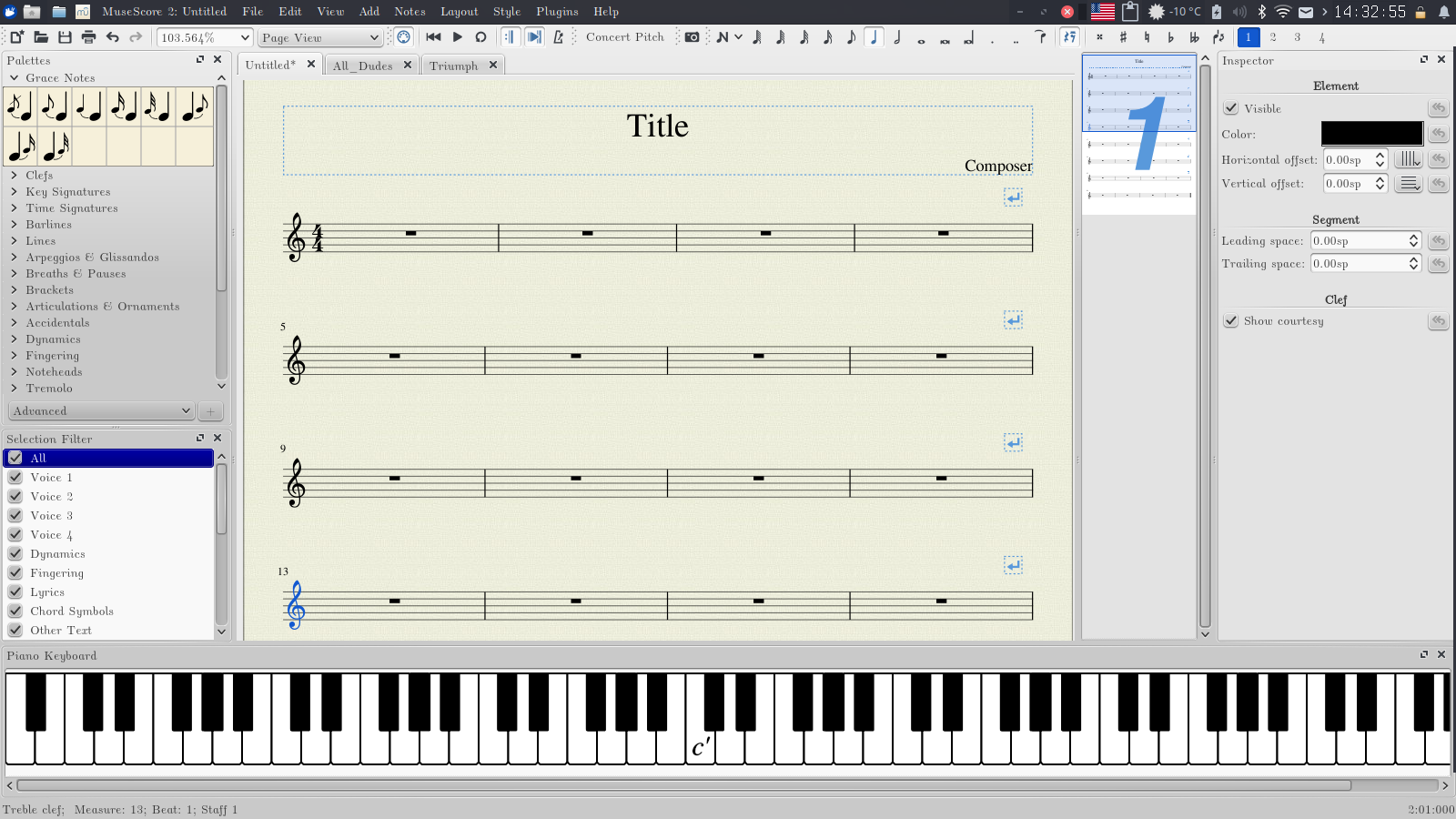
Screenshot with musescore, with CMU Classical font:
https://musescore.org/sites/musescore.org/files/2018-03/musescore_2018-03-1…
I guess (it is still my imho+taste), all these Serif/Concrete/Classical
fonts would look much better in rosegarden. Can't tell about other (even
musical) software, but for now i made "CMU Serif Upright Italic"
default font - in qt5ct, desktop appearance settings (xfce), and now
trying to get for qt4. It exactly works with qjackctl and musescore.
________________________________
About qtractor, if Rui Nuno Capella reads, there are few places,
where, where sans is forced:
- clock on toolbar,
- files list and track list use sans italic.
I don't know, is it sideback of setting to italic, but track list ruler
uses regular sans. But still, BPM display, near of clock,
followes system font.
Greetings gentlemen
It has been quite some time since I last wrote here.
Please forgive me for using this channel for such communication but we have
some news that are particularly interesting for this community in special.
MOD Devices is growing. You can read a bit here:
https://forum.moddevices.com/t/mod-devices-is-growing-up/2140
We're opening a job position specifically targeted to Linux Audio. Since
this is the place were most of the matching profiles communicate, I thought
it might be a good place to publish it here.
https://drive.google.com/file/d/1HKdWwhjeSPWywu-3gasz7OThbUClQ7dq/view?usp=…
Please contact us if interested and feel free to pass on to friends from the
Linux Audio community that you think might be interested.
Best regards
Gianfranco Ceccolini
+49 160 646 9313
+49 030 555 70435
gianfranco(a)moddevices.com
MOD Devices
Wilhelm-Kabus-Straße 21-35
10829 - Berlin
Hi all.
On Wednesday the 7th of March the monthly Berlin meeting is taking place at c-
base. I'll as usual be in the mainhall from 20:00.
See you there! :-)
Cheers
/Daniel
FFADO version 2.4.1 is now available, a package of userspace drivers for
firewire audio interfaces. This is a bugfix release with many of the
changes associated with the use of python3 and distribution packaging.
This is a source-only release which can be downloaded from the ffado.org
website at
http://ffado.org
or via the direct link:
http://ffado.org/files/libffado-2.4.1.tgz
Issues addressed in this release include:
* Fix some python syntax which was not compatible with python3. These
were missed during the preparation of FFADO 2.4.0.
* Modify the SCons build system to allow for scons running under python3.
As of this release there seem to be a number of issues in scons itself
when running under python3, so building FFADO in this environment is not
yet guaranteed.
* Merge distribution patches provided by package maintainers.
* Address some difficulties experienced by package maintainers when
compiling FFADO.
* Improve the output of ffado-diag.
Thanks to the developers and users who contributed to this release: Nicolas
Bouleng, Benoit Delcour, David Kastrup, Hector Martin, Orcan Ogetbil, Dave
Plater, David Runge, Jano Svitok and Jonathan Woithe. If an omission has
been made please contact us through the ffado-devel mailing list so this can
be corrected.
[Apologies for cross posting, please circulate widely.]
*New submission deadline: March 26, 2018*
1st International Faust Conference - Johannes Gutenberg University, Mainz
(Germany), July 17-18, 2018
The International Faust Conference (IFC-18: http://www.ifc18.uni-mainz.de)
will take place at the Johannes Gutenberg University
<http://www.uni-mainz.de/> of Mainz (Germany) on July 17-18, 2018. It aims
at gathering developers and users of the Faust programming language
<http://faust.grame.fr/> to present current projects and discuss future
directions for Faust and its community.
Participants will be able to share their work through paper presentations.
A series of round tables on various topics will serve as a platform to
brainstorm on Faust's features, semantics, tools, applications, etc. to
determine future directions for this language. Open spaces for demos and
workshops will be available for participants to openly share their ongoing
projects with the rest of the community.
As a special event, the winner of GRAME's Faust Open-Source Software
Competition will be announced during IFC-18.
IFC-18 is free and everyone is welcome to attend!
*Call for Papers*
We welcome submissions from academic, professional, independent
programmers, artists, etc. We solicit original papers centered around the Faust
programming language <http://faust.grame.fr/> in the following categories:
- Original research
- Technology tutorial
- Artistic project report (e.g., installation, composition, etc.)
Paper should be up to 14 pages in length, non anonymous, and formatted
according to this template
<http://www.ifc18.uni-mainz.de/misc/IFC-18-templates.zip>. *Submissions
should be carried out via our EasyChair portal
<https://easychair.org/conferences/?conf=ifc18>*.
All submissions are subject to peer review. Acceptance may be conditional
upon changes being made to the paper as directed by reviewers.
Accepted papers will be published on-line as well as in the IFC-18
proceedings paper version. They will be presented by their author(s) at
IFC-18 as 15 minutes presentations (+ 5 minutes for questions).
Feel free to contact us if you have any question.
*Important Dates*
- Papers submission deadline: March 26, 2018 March 2, 2018
- Notification of Acceptance: May 5, 2018 May 1, 2018
- Camera-Ready Version: June 1, 2018
*Call for Round Table Topics*
A series of round tables on the following themes will take place both
afternoons of IFC-18:
- Faust Tools (e.g., Architectures, IDE, Faust Code Generator, On-Line
Services, etc.)
- DSP in Faust and Faust Libraries (e.g., New Algorithms, New Libraries,
Missing Functions, etc.)
- Faust Compiler and Semantics
- Other Topics/Open Session
We solicit topic suggestions from the Faust community for each of these
themes. Topics can be submitted by means of this Google form
<https://goo.gl/forms/0fBYxk28jlRdtqRM2>. They will be introduced during
the round tables by the session chair.
*Contact*
Please, address your questions to: ifc18(a)muwiinfa.geschichte.uni-mainz.de
Conference website: http://www.ifc18.uni-mainz.de
--
Dr. Albert Gr"af
Computer Music Research Group, JGU Mainz, Germany
Email: aggraef(a)gmail.com
WWW: https://plus.google.com/+AlbertGraef