Hi,
I'm happy to announce release 0.5.1 of QMidiArp.
It brings some new features for Arp patterns suggested by gionnico
on
the tracker. New 't' and 'g' tokens provide semitone shifts, and
repeating '0' within chords play out several notes even when only one
note is pressed on the keyboard.
It also brings some sort of automation for the parameter storage
(see feature list
below) that might be interesting when working with live sequencing.
I've updated the demo_seqlfo.qmax that you'll find in
/usr/share/qmidiarp/examples
and you can download a
yoshimi xmz file made for that demo, from
the sourceforge qmidiarp 0.5.1 folder.
Check
it out, it's a nice sequence I think.
Enjoy playing with QMidiArp
Frank
-------------------
Everything as usual is on
http://qmidiarp.sourceforge.net
and the direct download link is
http://sf.net/projects/qmidiarp/files/qmidiarp/0.5.1/qmidiarp-0.5.1.tar.bz2…
Main changes are listed here:
qmidiarp-0.5.1 (2012-11-17)
New Features
o Global Storages have new features accessible through right-click
on each storage location. You can choose if at pattern end another
storage location is automatically selected and create dynamic pattern
sequences.
o Global Storage now has a position pacman indicator for each module
o Clicking on the top button in the global store window now raises the
selected module window
o When Jack is not available at program start, show a message window
o Introduce semitone shifts in Arp patterns (request 3574549 by gionnico)
o Allow repetition of the 0 note within chords to stack notes when only
a single note is played on the keyboard (request 3574549 by gionnico)
o The module input-output panels on the left can now be hidden, this
leaves some more space when running several modules side-by-side
Fixed Bugs
o When starting from scratch, qmidiarp sometimes didn't start with
internal clock
o When editing an arp pattern while running, qmidiarp crashed when the
pattern length reached zero
o Deleting the last module sometimes crashed qmidiarp
o Trigger mode sometimes caused hanging when a new note was received
o Global Storage locations did not get updated when module names changed
General Changes
o There have been many changes toward realtime compatibility under the
hood. In particular, there are no more memory allocations/frees in
the realtime component.
o LFO Waveforms with high resolutions and lengths appear with finer
streaks
o The Mute state of each module is no longer changed when a parameter
restore is done
o Overall CPU usage should be slightly reduced
Suil 0.6.6 is out. Suil is a lightweight C library for loading and
wrapping LV2 plugin UIs. Suil transparently presents UIs written in
any toolkit as the desired widget type of host programs, so hosts do
not have to depend on foreign toolkits.
This release fixes embedding Gtk in Qt, adds support for native
Windows UIs in Gtk, and fixes a few bugs. Updating is recommended,
particularly for Qt hosts.
Suil home: http://drobilla.net/software/suil/
Download: http://download.drobilla.net/suil-0.6.6.tar.bz2
Changes:
* Fix embedding Gtk in Qt as a child widget (support reparenting)
* Support for wrapping native Windows UIs in Gtk2
* Gracefully handle UIs with no port_event method
* Replace host provided features that match Suil implemented features,
rather than passing UIs duplicate features
* Disable timestamps in HTML documentation for reproducible build
Enjoy,
-dr
We are proud to announce the release of guitarix2-0.24.3.
Guitarix is a modular mono tube amplifier simulation for jack, with
additional mono/stereo effect racks which can be filled with in-build
effect plug-ins as well as with external LADSPA plug-ins.
Presets can be stored for single effects and complete rack settings.
All UI controllers could connected over jack midi via MIDI learn with
your external MIDI controllers.
Guitarix works on LINUX, FreeBSD, and MAC OSX
Installer (binary) package for MAC OSX is available here:
http://sourceforge.net/projects/guitarix/files/OSX/
This release comes with the following changes:
* fix new unsaved banks return no valid iter (GTK warning)
* add new nice dark-style rc-file
Guitarix is licensed under the GPL
Please refer to our project page for more information:
http://guitarix.sourceforge.net/
download site:
http://sourceforge.net/projects/guitarix/files
have fun
guitarix development team
I'm pleased to announce the release of a programmable metronome.
The click sound itself is built from up to 8 octaves of sound with some
natural resonance. The fundamental frequency is user choosable. You
are able to audition tempo and click sound through ALSA. Importantly,
the output can also be a 16 or 24 bit wave file for import into a DAW.
You can append to your click track file, changing tempo or meter as you
go. And best of all, you can read in a tempo map from a text file.
Grekim
The download is found in the "accessories" part of the page:
www.acousticrefuge.com/mixer4.htm
P.S. Someday, I'll find interesting names to these gadgets.
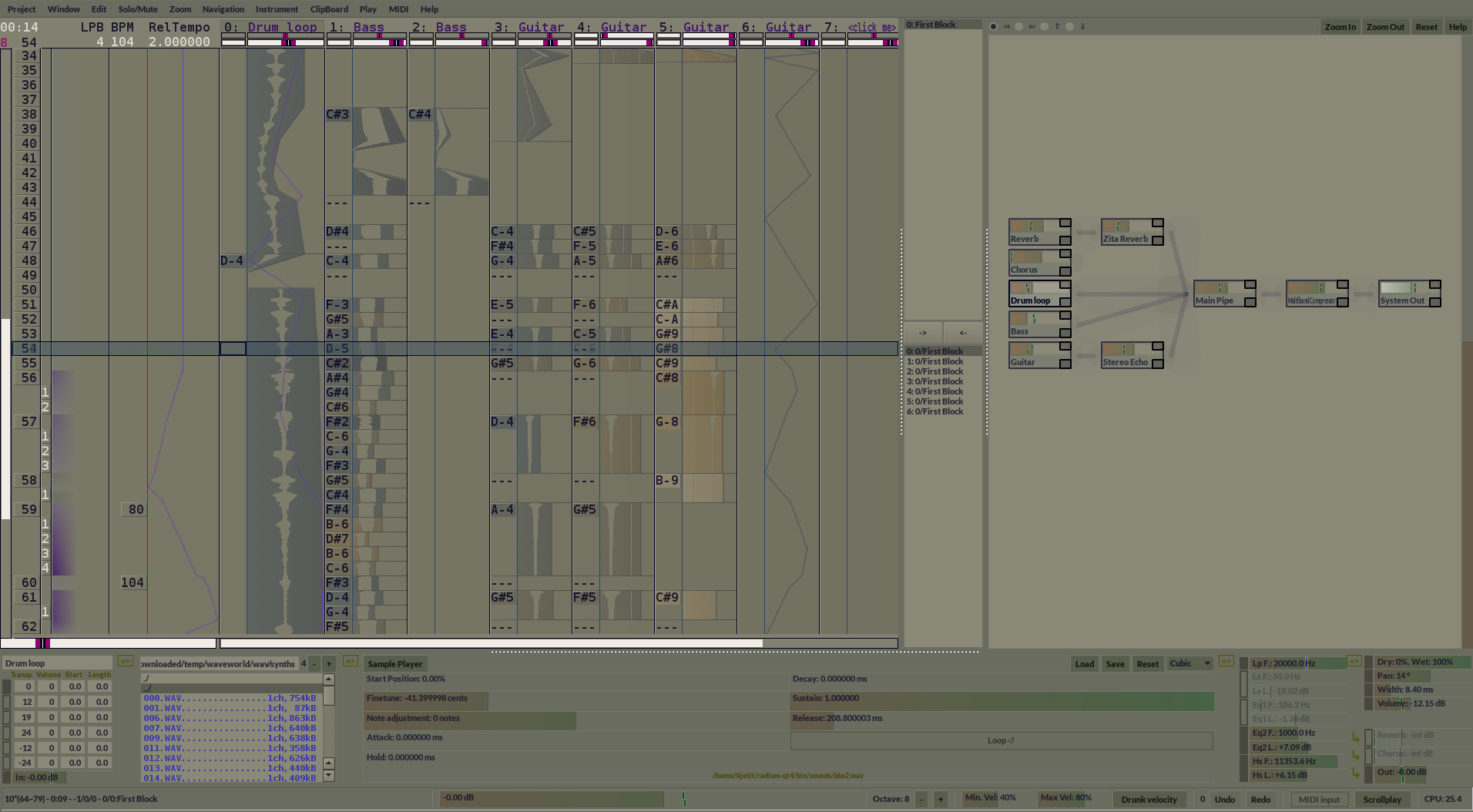
Radium is an open source music editor with a novel interface.
It's inspired by trackers, but has fewer limitations and uses graphics
to show musical data.
Screenshot:
===========
http://dl.dropbox.com/u/4814054/radium-1.9.1.png
Source code:
============
http://dl.dropbox.com/u/4814054/radium-1.9.1.tar.gz
64 bit binary:
===============
http://dl.dropbox.com/u/4814054/radium-1.9.1_linux64.tar.gz
(Requires GNU libc 2.14 or newer. It should work with Ubuntu 12,
Fedora 17 or Mint 13)
Homepage:
=========
http://users.notam02.no/~kjetism/radium/
(It's not quite updated, I can't seem to login to the web server right
now.)
Source code repository:
=======================
https://github.com/kmatheussen/radium
Most important changes 0.67.1 -> 1.9.1:
=======================================
* Audio.
* A quick-to-use modular mixer. Jack ports can be inserted anywhere.
* VST plugins and instruments (native, not via wine)
* LADSPA
* Fluidsynth instrument
* 20 STK instruments. (Physical modelling)
* Sampler instrument (soundfiles, xi instruments, soundfonts)
* Multiband compressor
(http://users.notam02.no/~kjetism/radium/pictures/screenshot-multiband.png)
* Built-in filters and equalizers.
* Simple arpeggiator
* Drunk input velocity
* Various GUI improvements
* Pitch expand made available in the menues.
* Tapiir plugin
* Zita reverb plugin
* Demo song
* Reconfigured keybindings
* Various bug fixes
Acknowledgment:
===============
Full list: http://users.notam02.no/~kjetism/radium/development.php
Especially thanks to Yann Orlarey for Faust, Julius O. Smith III for
the Faust filter and compressor code and more, Romain Michon for the
Faust
STK instruments, Fons Adriaensen for the amazing Zita reverb sound
(and Julius O. Smith III for the Faust implemention of it),
and Rui Nuno Capela for QTractor. (Plugin GUI code are based on code
taken from QTractor.)
A wild crosspost appears!
Laborejo, Esperanto for "Workshop", is used to craft music through notation.
It is a Lilypond GUI frontend, a MIDI creator and finally a tool collection to inspire and help you compose.
It works by reducing music-redundancy and by seperating layout and data.
Before you read the details make sure to connect to Laborejos Facebook, Twitter or Google Plus!
https://www.facebook.com/Laborejohttps://twitter.com/#!/Laborejohttps://plus.google.com/b/116744898976321238325/
Screenshot: http://www.laborejo.org/images/screenshots/latestscreenshot.png
This is the release of version 0.4
Download: https://github.com/nilsgey/Laborejo/tarball/0.4
Dependencies: http://www.laborejo.org/documentation
Linux Instructions: Unpack, cd into the created directoy, execute:
./laborejo-qt
Then use the number- and cursor keys for immediate success!
Check Help->Manual for navigational and note/rest entry keys. Everything else is in the menus.
New since version 0.3 (highlights):
* Lyrics are visible under the tracks directly and aligned to their notes
* Nicer cursor :)
* New dynamics like fp and sfz.
* New commandset for note speed entry with the numblock.
* Colored always-visible Marker in the GUI to indicate track groups. Also displays small instrument name for better orientation
* Lilypond binary and pdf viewer are now a config variable
* More Subsitutions (assign a pre-defined group to host notes. Group gets transposed and scaled accordingly). Final Fantasy arpeggio, common melody figures etc.
* Many bugfixes and small improvements that make the program work like you expected it to do anyway
Most important known problems:
* This is Alpha Grade Software. Don't use for long-term work. However, the produced midis and PDFs will last forever.
* There is no built-in jack midi output yet. You have to export midi files.
* Documentation is nearly non-existent.
* Deleting selected objects may result in strange gui behaviour. Nothing a save/reload can't fix for now.
Have fun, it would be nice to hear from you!
Nils
http://www.laborejo.org
-----BEGIN PGP SIGNED MESSAGE-----
Hash: SHA1
Hi LADs,
I'm pleased to declare http://ltcsmpte.sourceforge.net/ as deprecated
and release libltc-1.0.2 into the wild.
Linear (or Longitudinal) Timecode (LTC) is an encoding of SMPTE timecode
data as a Manchester-Biphase encoded audio signal. The audio signal is
commonly recorded on a VTR track or other storage media.
libltc is a LGPL library which provides functionality to encode and
decode LTC to/from timecode.
source: https://github.com/x42/libltc
documentation: http://x42.github.com/libltc/
In addition to a major API overhaul, libltc adds support for
vari-speed en/decoding and reverse LTC. Furthermore the LTC decoder's
accuracy and efficiency has been improved. The various tools that came
with ltcsmpte have been migrated to https://github.com/x42/ltc-tools .
A fully functional LTC slave and latency free encoder can be found in
Ardour3 since svn rev. 13390.
Many thanks to Chris Goddard who spent countless hours staring at
scopes, listening to LTC and doing real-world tests to assure sample
accuracy and quality in general.
Thanks to Jaromír Mikeš and Alessio Treglia libltc has already found
its way into debian.
happy A/V syncing,
robin
PS. The timecode conversion functions of ltcsmpte are in progress to
find their way into a standalone library which is still in the works.
-----BEGIN PGP SIGNATURE-----
Version: GnuPG v1.4.12 (GNU/Linux)
iQIcBAEBAgAGBQJQmUUhAAoJEKCQvOAs9X8Ec1MP/iarf4wfOyjxqA2HhDz4dZIS
QwUa7u7G3XwuJeHLnRPqgXxAyf9sh8lbjbGdz36TxCPU+7uWOnyQ9bjJ5OnNObae
c0J3etwhzbSMAlWBykLgUh7rGfhd998wArqnIYmruC8OwNrSNi0A1SWITwN1IGc/
tWJAz0RfTcLT89OekaH2HQOmiLolOkKP5b1MjeMb+cRK/V8Q2p1RFDzYbUTbqiAo
7htOMNGlRu9DkGq8PGeTc5C4IeLkktpvv/WatSTbFWazc9g/tJqlAzUUMeghWHN/
UanlPQC5p/a9ETFXlcmUFpW+RVE3M6nNCrHoi5EZiK3PkPdFJYvPFe6o3ITrKwkY
tBntWjp+j/nrOHeloBQLMKHBQEpqkNJYNKTIoJlvJTCoQH3798APwE2DHDW0ImJl
9tvu7otjCTsWECJ6CWqIo7sLcKfHsmtLm7kDiwdeIAnut230FwBAd7v/tGDBtZDh
7/JmrvWYQ37NXI2onl8hW3CJAfaAv7GAEeisAdzjADMnZb17uCRPRm8qw/StrjPS
od7k/oEcrxWSNk7m6WIg2M6NfzB1N1tGMSVxiK3f5YMb91CZ/buRDC4myWMMKibf
ST+HNhjWI9VpmOUymGqLV0jpkc4Gmym0pjqDfndCEkgVMmzUCtK/861ou4LS7GUq
YqFur38zbcUhsd+E3z6Z
=b5Mo
-----END PGP SIGNATURE-----
GeoSonix is a graphical music sequencer and music composition
environment I've been developing for over a year after forking it from
IanniX. I contributed to development of the previous version of
IanniX, but my goals differed from those of the IanniX team.
What distinguishes GeoSonix from IanniX is that it has much better
support for MIDI as well as built in support for the control and
generation of rhythmic music harmony, and "tonal music", the ability
to incorporate bitmap images into music generation, and many other
unprecedented capabilities for music composition. I will be
continuing to extend GeoSonix in these directions.
For examples of what GeoSonix can do, see my Vimeo site:
vimeo.com/user4679000/videos (and these are a tiny taste of its
capabilities).
Previously GeoSonix has been only available for Mac (and earlier, for
Windows) but I'm pleased to announce a first version for Linux.
You can download a binary version here (64 bit):
bitbucket.org/chrisgr99/geosonix/downloads.
Source code is also available from bitbucket.org/chrisgr99/geosonix
It's based on the Qt.
Warning: I developed and tested the Linux version on the one Linux
computer I have available here but I don't have another to confirm
portability. Please let me know ASAP if you find any problems, by
email to chrisgr99 at gmail dot com.
I welcome comments and suggestions.
- Chris Graham
On the eighth anniversary of hexter's first public release, I am
pleased to announce the new 1.0.0 version.
http://sourceforge.net/projects/dssi/files/hexter/1.0.0/
hexter is a software synthesizer that models the sound generation of
a Yamaha DX7 synthesizer. It can easily load most DX7 patch bank
files, edit those patches via a built-in editor or MIDI sys-ex
messages, and recreate the sound of the DX7 with greater accuracy
than any previous open-source emulation (that the author is aware
of...) hexter operates as a plugin for the DSSI Soft Synth
Interface.
Release 1.0.0 adds significant capability to hexter over the 0.6.2
release, including:
* An integrated patch editor (finally!)
* The option to use floating-point math in the synthesis code
instead of fixed-point.
* Performance optimizations.
* Better patch bank loading, thanks to Martin Tarenskeen.
* MIDI non-registered parameter (NRPN) support, thanks to Jamie
Bullock.
hexter is written and copyright (c) 2012 by Sean Bolton, and
licensed under the GNU General Public License, version 2 or later.
More information about hexter and DSSI can be found at:
http://dssi.sourceforge.net/hexter.html
Fomp is an LV2 port of the MCP, VCO, FIL, and WAH plugins by Fons
Adriaensen.
There are 13 plugins in total: 1 auto-wah, 1 EQ, 3 chorus, 5 filters,
and 3 oscillators.
The plugin implementations are identical to their LADSPA forebears,
except the primary frequency port of oscillators and filters has been
converted to Hz to facilitate use in any host without assuming the
hidden tuning frequency of AlsaModularSynth. All other frequency ports
remain as they were, using octaves for faithful Moog-like modulation.
Aside from that, the main benefit of these LV2 ports is improved
metadata: CV ports are distinguishable from audio ports, controls have
units where applicable, documentation is built-in for display in host
UIs, and so on.
The oscillators and filters are mainly useful in modular synthesizers,
but since CV ports are distinct from audio ports, they should work fine
in non-modular hosts as well.
Homepage: http://drobilla.net/software/fomp/
Download: http://download.drobilla.net/fomp-1.0.0.tar.bz2
Enjoy,
-dr